

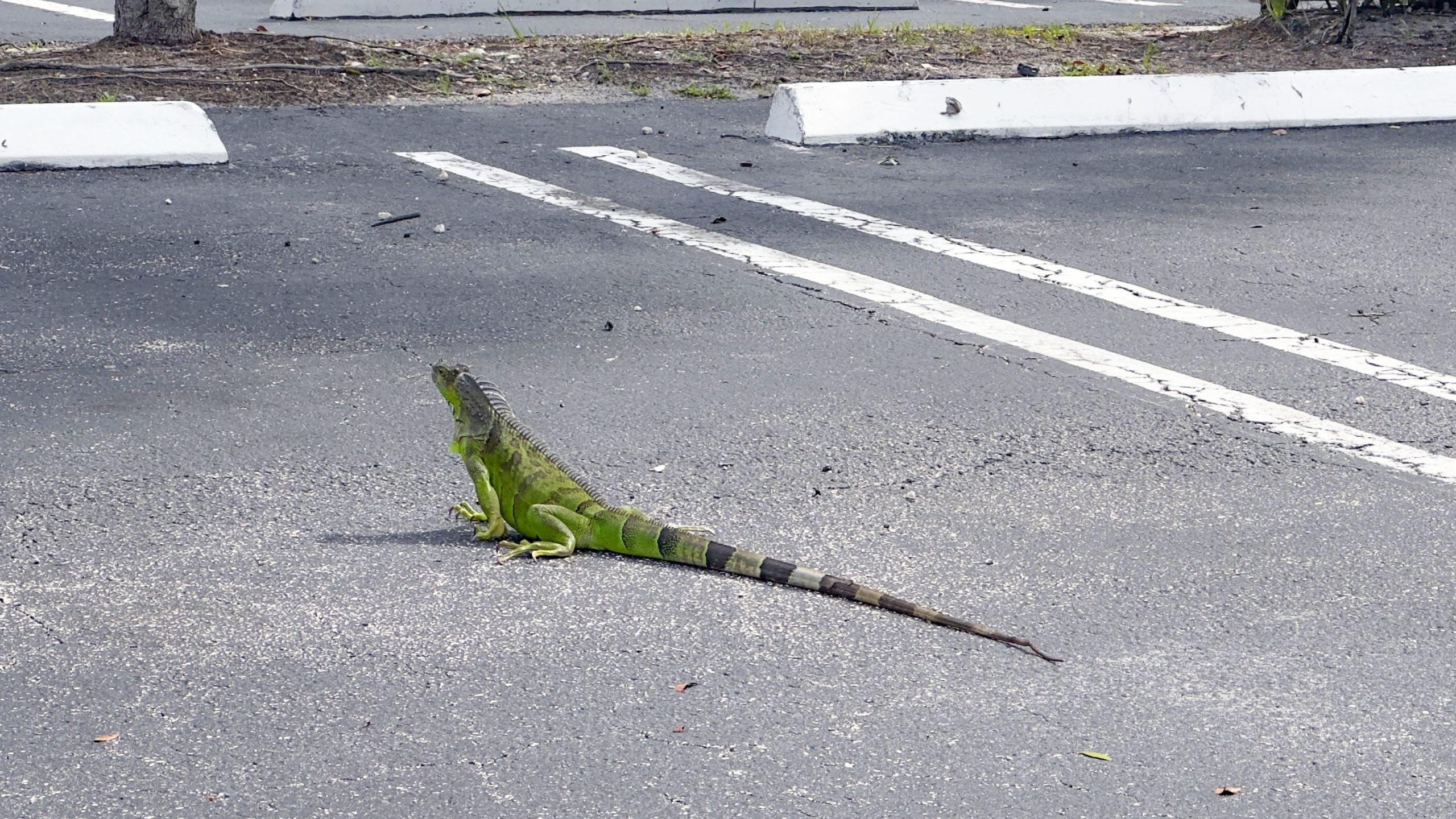
A Green Iguana “chills” in a parking lot in Boca Raton, FL. (Photo: Boca Daily News)
Don’t feed the iguanas in Boca Raton, or you may face a ticket under an ordinance introduced Tuesday night by the city council.
One of South Florida’s most infamous invasive species was one of several on a list of nuisance or vermin species on a list of animals that may no longer be fed by the public. Green iguanas, native to Central and South America, were first reported in South Florida in the 1960s in Miami-Dade County after 300 individuals were intentionally released by an exotic pet dealer in Hialeah, followed by subsequent escapes and releases through the illegal pet trade.
They are generally considered problematic in South Florida because they damage residential and commercial landscaping by consuming foliage, flowers, fruits and vegetables; dig burrows that erode and undermine sidewalks, foundations, seawalls, berms and canal banks, sometimes requiring costly repairs. They also leave droppings on docks, boats, porches and in pools, creating a nuisance and potential health concerns.
The ordinance that prohibits the feeding of iguanas also bars the feeding of rats, mice, and pigeons. It was introduced unanimously by the city council on Tuesday night and requires a public hearing and second vote for final adoption at the next meting. According to a memorandum prepared by city staff, the ordinance was proposed after concerns were brought up regarding the feeding of nuisance species, which attracts them to neighborhoods where they can begin to congregate in large numbers.
The ordinance bans the “placing, depositing, distributing, or leaving food in a quantity or manner reasonably likely to attract or sustain” the presence or congregation of iguanas, rats, mice, or pigeons. The ordinance focuses on the quantity and manner in which food is provided, and does not require the city to establish that a particular animal consumed the food or caused a particular instance of waste or property damage to constitute a violation.
The ordinance authorizes enforcement of the prohibition by code enforcement officers and calls for a minimum civil penalty of $100 per violation. Enforcement costs are expected to be offset by revenue generated by the new minimum civil penalty.



Police, Fire & Courts
Mother, Daughter Charged With Stealing From The Boca Raton Resort Shops


